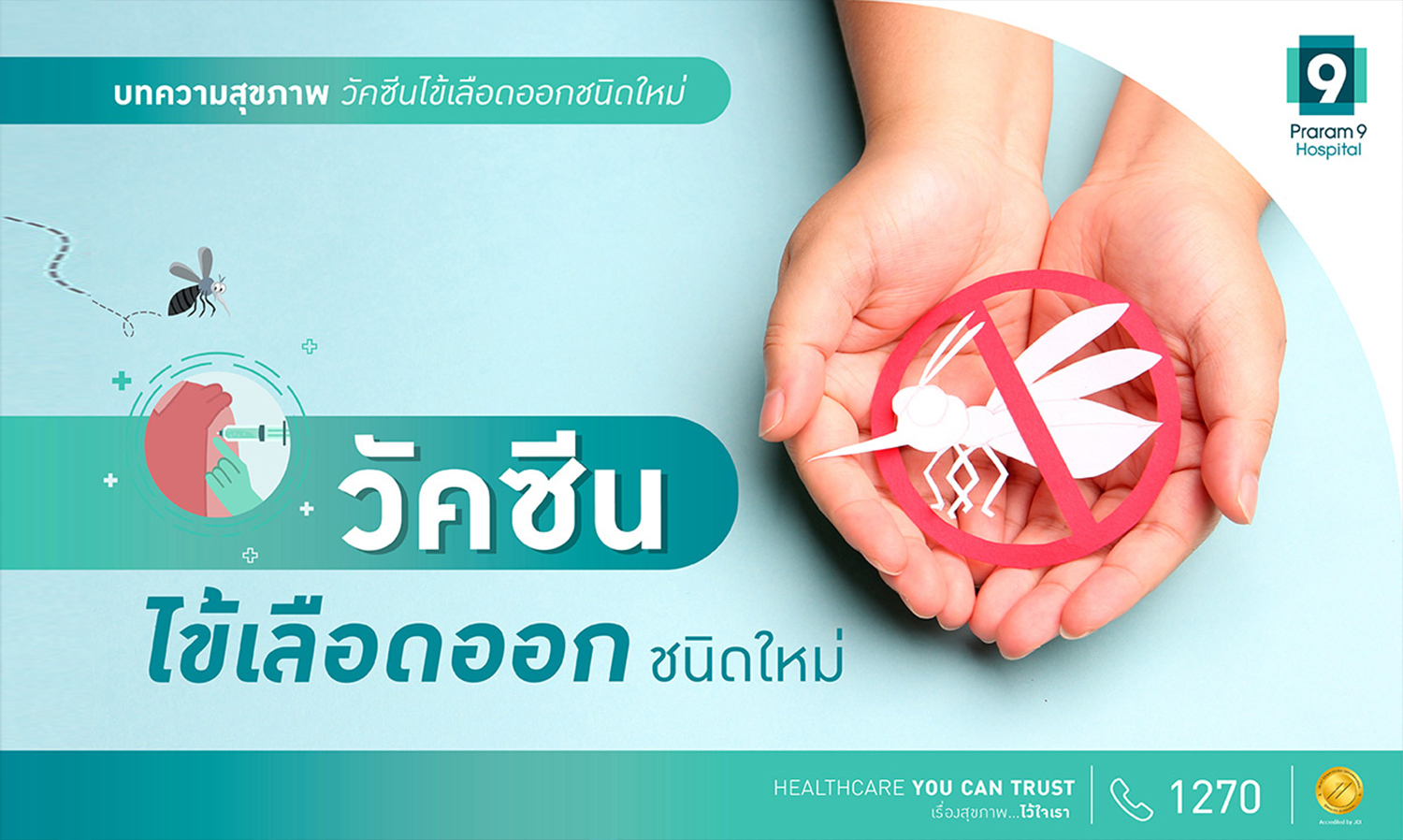
Dengue Fever Tops the List of Epidemic Diseases in Thailand for 2023, Three Times Higher with Risk of Recurrence
Dengue fever is an endemic disease in Thailand that occurs every year, especially during the rainy season, and the outbreak situation is trending upwards. Data from the Disease Surveillance System of the Epidemiology Bureau, Department of Disease Control, shows that the number of patients in 2023 is three times higher than in 2022, which is concerning. This highlights the importance of being aware of this disease, as although it is common and some patients may have mild symptoms, others can experience severe symptoms that may lead to death.
Dr. Jitthifa Hoorungroj, a specialist in preventive medicine, travel medicine, and vaccination at Rama 9 Hospital explains, "Dengue fever is caused by a virus known as dengue virus (DENV), which has four serotypes: Dengue 1 (DEN1), Dengue 2 (DEN2), Dengue 3 (DEN3), and Dengue 4 (DEN4). Once infected with any one serotype, the body will have lifelong immunity to that specific serotype but will not be immune to the others. Therefore, patients can be infected with different serotypes and suffer from dengue fever more than once if they contract another serotype later. The severity of the illness varies depending on the serotype and the strength and health of the infected individual. Dengue fever can occur at any age, with the highest incidence in children aged 5-14 years, and in the last 20 years, there has been an increasing trend of infections in adolescents and adults, which is becoming more dangerous."
Meanwhile, the Department of Disease Control has revealed the situation of communicable diseases that have been prevalent in Thailand in 2023. Statistics from January 1 to December 13, 2023, show that dengue fever had the highest number of cases, totaling 147,412, with an incidence rate of 222.91 per 100,000 population. This is 3.4 times higher than the previous year, with cases spread across the country. There were 174 confirmed laboratory deaths from 57 provinces, resulting in a case fatality rate of 0.12%, with the highest fatality rate in the 25-34 age group, mostly among those with chronic underlying conditions and obesity. Laboratory tests in deceased patients revealed all four dengue virus serotypes, with DENV-2 being the most prevalent, followed by DENV-1, DENV-3, and DENV-4.
Individuals can be infected with dengue fever more than once with different serotypes from the first infection.
Dr. Jitthifa further explains: "Thailand has experienced outbreaks of all four serotypes mentioned above, which circulate at different times, with serotypes 1 and 2 being the most common. The first infection usually presents with mild symptoms, and the body will have lifelong immunity to that serotype. However, a second infection with a different serotype may result in more severe symptoms."
The symptoms of dengue fever in the early stages typically include a sudden high fever, exceeding 38.5 degrees Celsius, headache, eye pain, body aches, nausea, vomiting, and possibly bleeding spots on the arms, legs, and torso. Some patients may experience nosebleeds or bleeding gums. Symptoms of dengue fever can become severe between days 3-7 of the illness, leading to severe abnormal bleeding, shock, and potentially death.
While the best prevention against dengue fever is to avoid mosquito bites and eliminate mosquito breeding sites around the home, vaccination against dengue fever is another method that can help prevent the disease and reduce its severity. Currently, there are two dengue vaccines registered in Thailand that can protect against all four dengue virus serotypes.
The first vaccine (Dengvaxia®) has been used in Thailand since 2017. It is a live attenuated vaccine that effectively protects against serotypes 3 and 4 but provides moderate protection against serotypes 1 and 2. It has a 65% efficacy in preventing dengue fever and an 80% efficacy in preventing hospitalization, administered in three doses spaced six months apart, and is suitable for individuals aged 6-45 years who have previously contracted dengue fever. It is found that administering it to individuals who have never been infected with dengue fever increases the risk of severe symptoms.
The second dengue vaccine (QDenga®) is a new vaccine that has been used in 16 countries worldwide and was registered for use in Thailand in 2023. It is a live attenuated vaccine that provides good protection against serotypes 1 and 2, which are the most common in Thailand. It is administered in two doses, with a three-month interval between the first and second doses.
- It can be administered to individuals aged 4-60 years, including those who have and have not previously contracted dengue fever, and there is no need for a blood test to check for dengue immunity before vaccination.
- It has an overall efficacy of 80% in preventing dengue fever.
- It can prevent hospitalization due to dengue fever by up to 90%.
However, it is advisable to consult a physician before receiving the vaccine for effectiveness and safety.
You can find more information about the new dengue vaccine at https://www.praram9.com/dengue-vaccine-2566/ or consult with a specialist at Rama 9 Hospital by calling 1270 or visiting www.praram9.com / Line: lin.ee/vR9xrQs or @praram9hospital and on Facebook: Praram9 Hospital. Rama 9 Hospital HEALTHCARE YOU CAN TRUST #HealthMatters #Praram9Hospital #DengueFever #DengueVaccine